
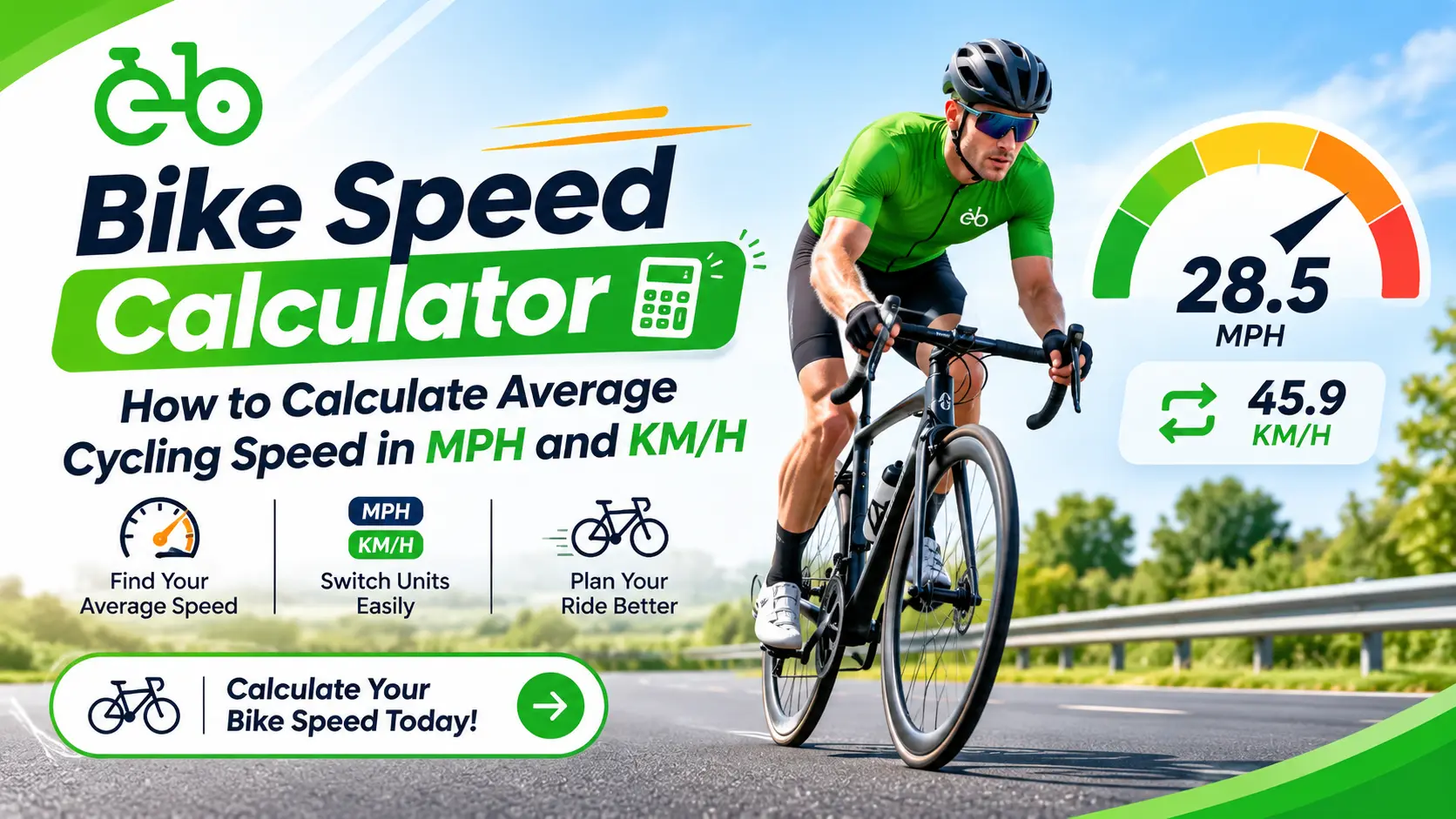


Bike speed calculator may help you calculate your average cycling speed using the distance traveled and the time spent riding. Whether you are commuting to work, cycling for exercise, or preparing for a long-distance ride, knowing your average speed helps you understand your performance and estimate travel time.
You can calculate cycling speed in miles per hour (MPH) or kilometers per hour (KM/H) using a simple formula. All you need is your cycling distance and total riding time.
In this guide, you’ll learn how to calculate bike speed, convert between MPH and KM/H, understand average cycling speeds, and identify the factors that influence how fast you ride.
What Is a Bike Speed Calculator?
A bike speed calculator is a tool that calculates your average cycling speed based on the distance you travel and the time it takes to complete your ride. It uses a mathematical formula to determine how many miles or kilometers you cover per hour.
For example, if you cycle 20 kilometers in one hour, your average speed is 20 KM/H. Similarly, if you travel 15 miles in one hour, your average cycling speed is 15 MPH.
A bicycle speed calculator is useful for different types of riders, including beginners, recreational cyclists, daily commuters, and experienced road cyclists.
You can use it to:
- Calculate your average cycling speed in MPH or KM/H.
- Compare your cycling performance across different rides.
- Estimate how long a particular cycling route will take.
- Determine the distance you can travel at a specific speed.
- Monitor improvements in your cycling endurance and efficiency.
Unlike a traditional bicycle speedometer, which can display your current speed while riding, a basic bike speed calculator determines your average speed using distance and time measurements.
How to Use a Bike Speed Calculator
Using a bike speed calculator is straightforward. You only need to know your total cycling distance and the amount of time you spent completing the ride.
The calculator uses these measurements to determine your average speed.
Step 1: Enter Your Cycling Distance
Start by entering the total distance you traveled. You can use kilometers or miles, depending on your preferred measurement system.
For example, if you completed a 25-kilometer cycling route, enter 25 and select kilometers.
Step 2: Enter Your Total Riding Time
Next, enter the time required to complete your ride. Depending on the calculator, you may need to enter your time in hours, minutes, or seconds.
Suppose you cycled for 1 hour and 30 minutes. This equals 1.5 hours when converted into decimal form.
Make sure you know whether your recorded time includes stops, because moving time and total elapsed time can produce different average speeds.
Step 3: Select MPH or KM/H
Choose the speed measurement unit you want to use.
- MPH: Miles per hour, commonly used in the United States and United Kingdom.
- KM/H: Kilometers per hour, used in many other countries.
Selecting the appropriate unit makes it easier to understand and compare your results.
Step 4: Calculate Your Average Speed
After you enter the distance and time, use the speed formula to find your average cycling speed.
For example, if you travel 30 kilometers in 1.5 hours:
30 ÷ 1.5 = 20 KM/H
Your average bike speed is 20 kilometers per hour.
You can use this result to estimate future riding times or compare your performance with previous cycling sessions.
Bike Speed Calculator Formula Explained
The bike speed formula is based on the relationship between speed, distance, and time. It works for different types of bicycles, including road bikes, mountain bikes, hybrid bicycles, and electric bikes.
The basic formula is:
Average Speed = Total Distance ÷ Total Time
To get an accurate result, the time must be expressed in hours when calculating MPH or KM/H.
How to Calculate Bike Speed in MPH
Miles per hour measures how many miles you travel during one hour of cycling.
The formula is:
Speed (MPH) = Distance (Miles) ÷ Time (Hours)
Let’s say you cycle 15 miles in one hour.
- Distance: 15 miles
- Time: 1 hour
- Calculation: 15 ÷ 1
Your average speed is 15 MPH.
Now suppose you cycle 24 miles in two hours.
24 ÷ 2 = 12 MPH
Your average cycling speed is 12 MPH, even if your speed changes during different parts of the ride.
How to Calculate Bike Speed in KM/H
Kilometers per hour measures how many kilometers you travel in one hour.
The formula is:
Speed (KM/H) = Distance (Kilometers) ÷ Time (Hours)
For example, suppose you complete a 30-kilometer cycling route in 1.5 hours.
- Distance: 30 kilometers
- Time: 1.5 hours
- Calculation: 30 ÷ 1.5
Your average bike speed is 20 KM/H.
This formula also works for shorter rides. If you travel 10 kilometers in 30 minutes, convert 30 minutes into 0.5 hours.
10 ÷ 0.5 = 20 KM/H
Even though you only rode for half an hour, your average speed is still 20 kilometers per hour.
How to Convert Bike Speed Between MPH and KM/H
Cyclists sometimes need to convert speed measurements when comparing riding statistics, using cycling applications, or following training programs.
You can convert between MPH and KM/H using these formulas:
MPH to KM/H:
Speed in MPH × 1.609344 = Speed in KM/H
KM/H to MPH:
Speed in KM/H × 0.621371 = Speed in MPH
For example, cycling at 15 MPH is approximately 24.14 KM/H.
Here is a quick conversion table:
| Speed (MPH) | Speed (KM/H) |
| 5 MPH | 8.05 KM/H |
| 10 MPH | 16.09 KM/H |
| 12 MPH | 19.31 KM/H |
| 15 MPH | 24.14 KM/H |
| 20 MPH | 32.19 KM/H |
| 25 MPH | 40.23 KM/H |
| 30 MPH | 48.28 KM/H |
These conversions help you compare cycling speeds regardless of the measurement system being used.
What Is the Average Bike Speed for Different Cyclists?
Average bike speed varies depending on cycling experience, physical fitness, bicycle type, and riding conditions. A beginner cycling through city traffic will generally maintain a different average speed than an experienced cyclist riding on a flat road.
No single cycling speed is ideal for everyone. However, general speed ranges can help you understand what to expect.
The following figures are illustrative estimates, not universal performance standards.
| Cyclist Type | Average Speed (KM/H) | Average Speed (MPH) |
| Beginner cyclist | 10–15 KM/H | 6.2–9.3 MPH |
| Recreational cyclist | 15–20 KM/H | 9.3–12.4 MPH |
| Regular fitness cyclist | 20–25 KM/H | 12.4–15.5 MPH |
| Experienced road cyclist | 25–30 KM/H | 15.5–18.6 MPH |
| Fast or competitive cyclist | 30+ KM/H | 18.6+ MPH |
Average Speed for Beginner Cyclists
Beginner cyclists often focus on maintaining balance, developing endurance, and becoming comfortable with different riding conditions.
On relatively flat roads, beginners may average about 10–15 km/h, or 6–9 mph. However, their actual speed may be lower on crowded streets, steep routes, or uneven surfaces.
For beginners, building consistency and confidence is usually more important than reaching a particular speed.
Average Speed for Recreational Cyclists
Recreational cyclists typically ride for exercise, transportation, or enjoyment rather than competitive performance.
They may maintain an average speed of approximately 15–20 KM/H, depending on their fitness level and route conditions.
A recreational cyclist who regularly rides on smooth, open roads may achieve a higher average than someone navigating busy urban streets.
Average Speed for Experienced Road Cyclists
Experienced road cyclists often build endurance, pacing skills, and riding efficiency through regular training.
Under favorable conditions, they may maintain average speeds of approximately 25–30 KM/H or more.
However, these speeds depend heavily on terrain, weather, ride duration, and whether the cyclist is riding alone or in a group.
Average Speed for Electric Bike Riders
Electric bikes use motor assistance to make pedaling easier, especially during acceleration and uphill riding.
Average speeds vary based on motor assistance settings, rider effort, traffic conditions, terrain, and local regulations.
For example, an electric bike with pedal assistance up to 25 KM/H may help a rider maintain a relatively consistent pace on suitable routes. However, that assistance limit is not necessarily the rider’s average speed or the bicycle’s absolute maximum speed.
The same bike speed calculator formula applies to electric bikes because speed is still determined by distance divided by time.
What Factors Affect Your Average Cycling Speed?
Several factors influence how fast you can ride a bicycle. Understanding these factors helps you interpret the results from an average bike speed calculator and identify areas where you might improve your performance.
Bicycle Type and Weight
The type of bicycle you ride can affect your speed, especially because different bikes are designed for different surfaces and riding styles.
Road bikes generally use lightweight frames, narrower tires, and riding positions designed for efficient cycling on paved roads.
Mountain bikes typically have wider tires, suspension components, and stronger frames suitable for rough terrain. These features may increase rolling resistance or weight on smooth roads but improve control and traction on difficult surfaces.
The bicycle’s overall weight can also affect acceleration and climbing performance.
Road Surface and Terrain
Terrain is one of the most important factors affecting cycling speed.
Flat, smooth roads generally make it easier to maintain a consistent pace. Hills require additional effort because the cyclist must work against gravity while climbing.
Rough roads, gravel paths, and technical mountain biking trails can also reduce average speed because riders need to slow down to maintain control.
Wind and Weather Conditions
Wind resistance can significantly influence cycling performance.
A strong headwind makes it harder to maintain speed because you must overcome additional aerodynamic resistance. A tailwind may make it easier to travel at a faster pace.
Rain, poor visibility, and slippery road surfaces can also require slower riding for safety.
When comparing cycling performance, it is useful to consider the weather conditions during each ride.
Rider Fitness and Experience
Cycling fitness plays a major role in determining average speed.
Regular cyclists often develop stronger cardiovascular endurance, improved muscular stamina, and more efficient pedaling techniques.
Experienced riders may also become better at managing their effort over longer distances.
However, fitness improvements usually develop gradually, and cycling performance differs from person to person.
Tire Pressure and Bike Maintenance
A properly maintained bicycle can operate more efficiently than one with mechanical problems.
Underinflated tires, poorly maintained chains, rubbing brakes, and worn drivetrain components can create additional resistance.
Regularly checking tire pressure, lubricating the chain appropriately, and maintaining the braking system can help keep your bicycle performing reliably.
Always follow the manufacturer’s recommended tire pressure and maintenance guidelines.
How to Calculate Cycling Time and Distance
A bike speed calculator can do more than calculate average speed. The relationship between speed, distance, and time also allows you to estimate how long a ride may take or how far you can travel.
These calculations are useful for commuting, trip planning, and cycling workouts.
Calculate Bike Ride Time Using Distance and Speed
To estimate how long a cycling trip will take, divide the distance by your expected average speed.
The formula is:
Time = Distance ÷ Speed
For example, suppose you plan to cycle 40 kilometers at an average speed of 20 KM/H.
40 ÷ 20 = 2 hours
Your estimated cycling time is two hours.
If you are planning a commute or longer trip, remember to account for traffic lights, rest breaks, and other interruptions.
A bike ride time calculator can help estimate travel duration, but the result depends on the average speed you actually maintain.
Calculate Cycling Distance Using Speed and Time
You can also estimate your cycling distance when you know your average speed and total riding time.
The formula is:
Distance = Speed × Time
For example, suppose you ride at an average speed of 18 KM/H for two hours.
18 × 2 = 36 kilometers
You would travel approximately 36 kilometers.
This calculation is particularly useful when planning exercise sessions or determining how far you can ride within a limited amount of time.
Average Cycling Speed vs. Maximum Cycling Speed
Average cycling speed and maximum cycling speed are two different measurements.
Average cycling speed represents the total distance traveled divided by the time taken. It shows your overall riding pace during a particular trip.
Maximum cycling speed represents the highest speed you reach at a specific moment.
For example, you might reach 40 KM/H while cycling downhill but complete the entire route at an average speed of only 18 KM/H.
Maximum speed reflects a brief peak, while average speed provides a better indication of your overall riding pace.
Cycling devices may also distinguish between moving average speed and overall average speed.
Moving average speed uses the time spent moving, whereas overall average speed uses the full elapsed time, including stops.
If you cycle 20 kilometers in one hour of moving time but spend an additional 20 minutes resting, your moving average speed is 20 KM/H, while your overall average speed is approximately 15 KM/H.
Understanding the difference helps you interpret cycling data more accurately.
How to Improve Your Average Bike Speed
Improving your average cycling speed involves more than simply pedaling harder. Consistent training, efficient riding habits, and proper bicycle maintenance can improve performance.
The following strategies can help you improve your cycling efficiency over time.
Build Cycling Endurance
Regular cycling helps develop cardiovascular fitness and muscular endurance.
Begin with distances that match your current ability, then gradually increase your riding duration as you become more comfortable.
Improving endurance can make it easier to maintain a consistent speed over longer distances.
Maintain a Consistent Riding Pace
Instead of riding at maximum effort from the beginning, try to maintain a comfortable and sustainable pace.
Frequent unnecessary acceleration followed by slowing down can make long rides more tiring.
Learning to manage your effort allows you to maintain a steadier average speed throughout your trip.
Improve Your Riding Position
Your riding position can affect comfort, aerodynamics, and cycling efficiency.
A suitable bicycle fit helps you maintain control while pedaling comfortably.
On road bikes, a more aerodynamic position may reduce wind resistance, although comfort and safe handling should remain priorities.
Maintain Your Bicycle Regularly
Mechanical problems can reduce cycling efficiency and create unnecessary resistance.
Check your tires, chain, brakes, and drivetrain before important rides.
Keeping your bicycle in good mechanical condition helps support efficient and safer cycling.
Track Your Progress With a Cycling Speed Calculator
Regularly monitoring your average speed helps you understand your cycling performance.
Use a cycling speed calculator to compare rides completed over similar distances and terrain.
For example, if you previously cycled 20 kilometers in 75 minutes but later completed the same route in 65 minutes, your average speed increased.
Tracking these changes can help you recognize progress without focusing exclusively on maximum speed.
Common Mistakes to Avoid When Calculating Bike Speed
Although the bike speed formula is simple, incorrect measurements can produce misleading results.
One common mistake is entering minutes directly into a formula that requires hours. For example, 30 minutes must be converted to 0.5 hours before calculating speed in MPH or KM/H.
Another mistake is mixing measurement units. Dividing kilometers by hours gives KM/H, while dividing miles by hours gives MPH.
Cyclists may also confuse moving time with total elapsed time. Including rest stops produces a lower overall average speed than calculating speed using moving time alone.
Finally, a calculated average speed does not mean you maintained exactly the same speed throughout the ride. Your speed can change depending on hills, traffic, wind, and other conditions.
Using consistent measurements and understanding these differences helps ensure more meaningful calculations.
Frequently Asked Questions About Bike Speed Calculators
How do I calculate my average bike speed?
To calculate your average bike speed, divide your total cycling distance by your riding time in hours. For example, cycling 30 kilometers in two hours gives an average speed of 15 KM/H.
What is the average cycling speed in MPH?
Most cyclists average about 9–12 MPH under suitable conditions, while experienced road cyclists may maintain higher speeds based on their ability. Performance depends on your fitness level, bicycle type, terrain, and cycling goals.
How fast is 20 KM/H in MPH?
20 KM/H is approximately 12.43 MPH. To convert kilometers per hour into miles per hour, multiply the speed by 0.621371.
How long does it take to bike 10 miles?
At an average speed of 10 MPH, cycling 10 miles takes approximately one hour. At 15 MPH, the same distance takes about 40 minutes, excluding additional stops.
Is 15 MPH a good cycling speed?
An average speed of 15 MPH can represent a solid recreational cycling pace. However, whether it is good depends on your riding experience, route conditions, bicycle type, and overall fitness.
Can I calculate bike speed without a speedometer?
Yes. You can calculate average bike speed without a speedometer if you know the distance traveled and the time taken. Divide the distance by the time in hours to determine your average speed.
Does a bike speed calculator work for electric bikes?
Yes. A bike speed calculator works for electric bikes because the calculation uses distance and time. However, electric bike speed can also be influenced by motor assistance, battery condition, terrain, and local regulations.
Summary
Bike speed calculator provides a simple way to calculate your average cycling speed in MPH or KM/H using distance and time. Whether you ride a traditional bicycle or an electric bike, understanding your average speed helps you monitor your performance, estimate travel time, and plan cycling routes.
The formula is straightforward: divide the total distance traveled by the time taken in hours. You can also rearrange the formula to calculate expected cycling time or distance.
By tracking your results consistently and considering factors such as terrain, weather, and riding conditions, you can better understand your cycling performance and make more informed decisions about future rides.


Leave a Comment